
Paper 2602.15763
GLM-5: from Vibe Coding to Agentic Engineering
- Published
- Feb 2026
- Research lab
- Z.ai / GLM
- Citations
- 295
- GitHub
- 6.9K stars
01 In brief
Summary
GLM-5, developed by Zhipu AI and Tsinghua University, is a next-generation foundation model that shifts from vibe coding to agentic engineering.
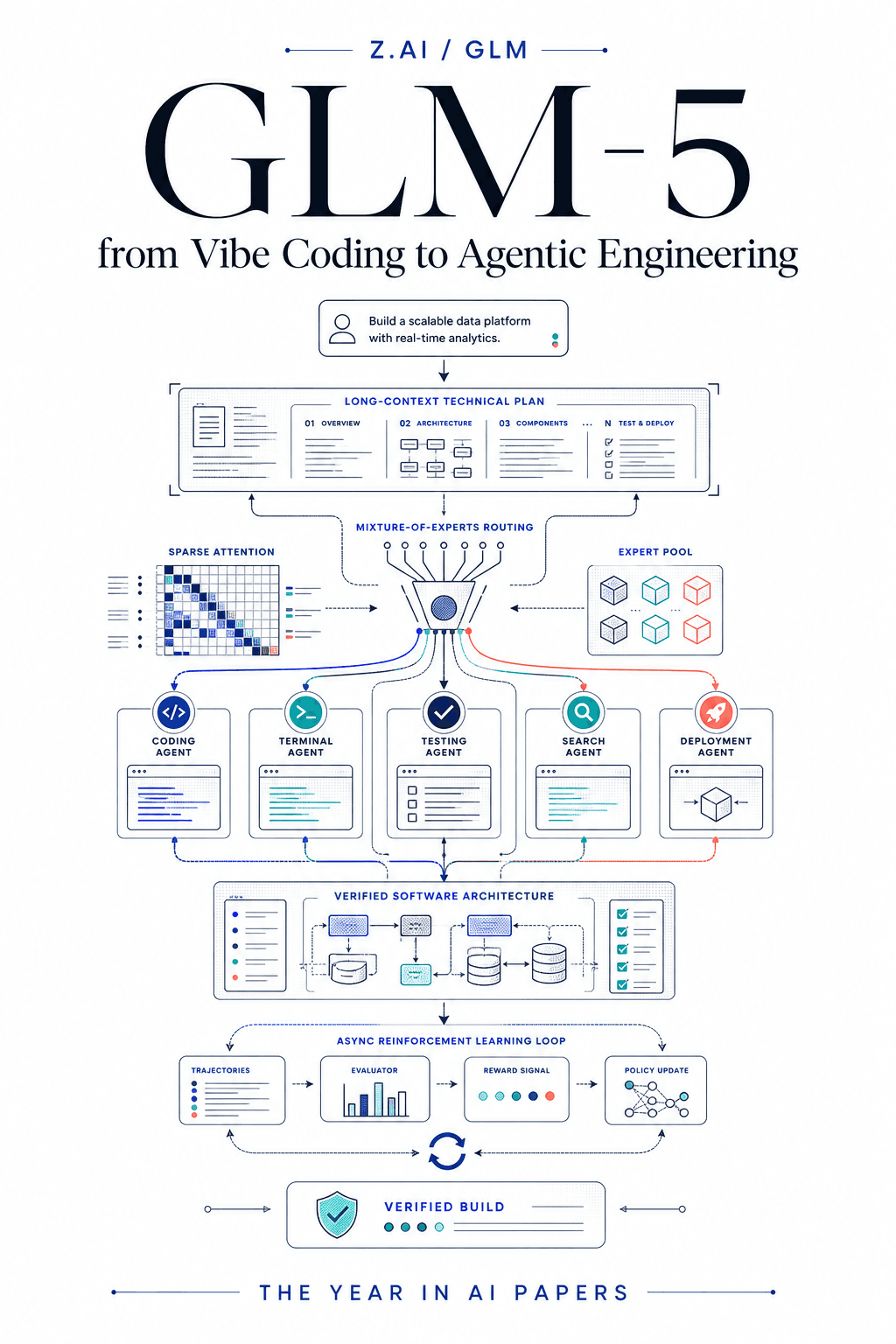
It builds on the ARC (agentic, reasoning, coding) capabilities of its predecessor, GLM-4.7, and introduces DeepSeek Sparse Attention (DSA) to reduce training and inference costs while maintaining long-context fidelity.
The model scales to 744B total parameters (40B active) and is trained on 28.5T tokens.
A new asynchronous reinforcement learning infrastructure decouples generation from training, improving post-training efficiency, and novel asynchronous agent RL algorithms enhance learning from long-horizon interactions.
GLM-5 achieves state-of-the-art performance on benchmarks like SWE-bench Verified (77.8), BrowseComp (75.9 with context management), and scores 50 on the Artificial Analysis Intelligence Index v4.0, the first open-weights model to do so.
It also demonstrates strong long-horizon task performance, e.g., $4,432 on Vending-Bench 2.
The model is full-stack adapted to Chinese GPU ecosystems, including Huawei Ascend and Moore Threads.
GLM-5 is released open-source, with code and models available at https://github.com/zai-org/GLM-5.
02 From the paper
Abstract
We present GLM-5, a next-generation foundation model designed to transition the paradigm of vibe coding to agentic engineering. Building upon the agentic, reasoning, and coding (ARC) capabilities of its predecessor, GLM-5 adopts DSA to significantly reduce training and inference costs while maintaining long-context fidelity. To advance model alignment and autonomy, we implement a new asynchronous reinforcement learning infrastructure that drastically improves post-training efficiency by decoupling generation from training. Furthermore, we propose novel asynchronous agent RL algorithms that further improve RL quality, enabling the model to learn from complex, long-horizon interactions more effectively. Through these innovations, GLM-5 achieves state-of-the-art performance on major open benchmarks. Most critically, GLM-5 demonstrates unprecedented capability in real-world coding tasks, surpassing previous baselines in handling end-to-end software engineering challenges. Code, models, and more information are available at https://github.com/zai-org/GLM-5.