

Paper 2508.10104
DINOv3
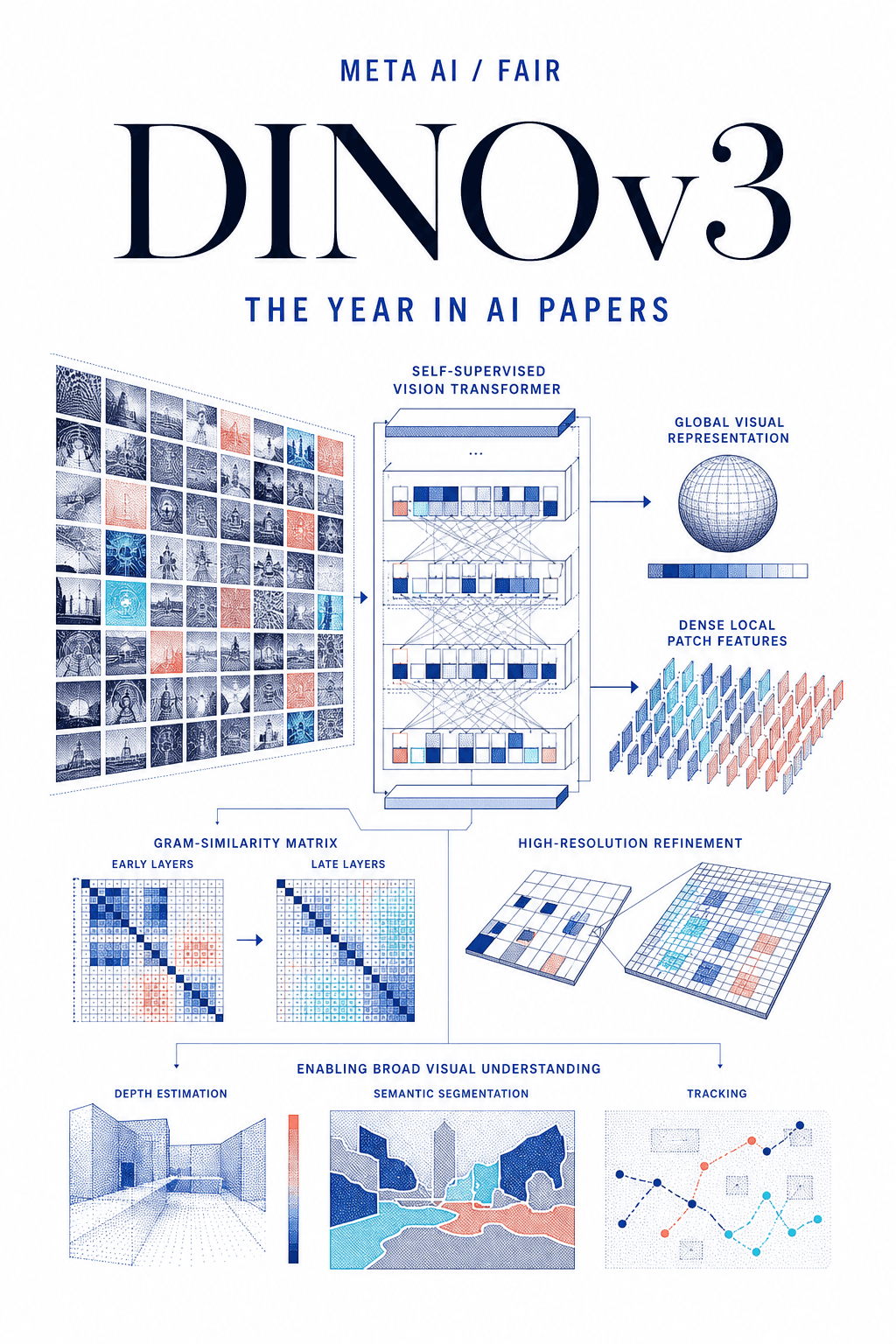
01 In brief
Summary
DINOv3 is a self-supervised vision foundation model that scales to 7B parameters, trained on a curated dataset of 1.689 billion images (LVD-1689M) from Instagram, combined with ImageNet-1k.
The model uses a ViT architecture with RoPE embeddings and constant hyperparameter schedules.
A key contribution is Gram anchoring, a regularization technique that mitigates the degradation of dense feature maps during long training by aligning the Gram matrix of student features with an early teacher.
Post-training includes high-resolution adaptation, distillation into smaller ViT and ConvNeXt variants, and text alignment.
DINOv3 achieves state-of-the-art results on dense tasks (e.g., ADE20k mIoU 55.9 with linear probing, 63.0 with a decoder) and competitive global performance, outperforming weakly-supervised models like CLIP derivatives.
It also excels in object detection (COCO mAP 66.1), depth estimation, 3D correspondence, and video tracking.
A satellite-specific variant trained on SAT-493M improves canopy height estimation and geospatial tasks.
The training consumed 47 MWh (18 tCO2eq) for the 7B model, with a total project footprint of ~2600 tCO2eq.
02 From the paper
Abstract
Self-supervised learning holds the promise of eliminating the need for manual data annotation, enabling models to scale effortlessly to massive datasets and larger architectures. By not being tailored to specific tasks or domains, this training paradigm has the potential to learn visual representations from diverse sources, ranging from natural to aerial images -- using a single algorithm. This technical report introduces DINOv3, a major milestone toward realizing this vision by leveraging simple yet effective strategies. First, we leverage the benefit of scaling both dataset and model size by careful data preparation, design, and optimization. Second, we introduce a new method called Gram anchoring, which effectively addresses the known yet unsolved issue of dense feature maps degrading during long training schedules. Finally, we apply post-hoc strategies that further enhance our models' flexibility with respect to resolution, model size, and alignment with text. As a result, we present a versatile vision foundation model that outperforms the specialized state of the art across a broad range of settings, without fine-tuning. DINOv3 produces high-quality dense features that achieve outstanding performance on various vision tasks, significantly surpassing previous self- and weakly-supervised foundation models. We also share the DINOv3 suite of vision models, designed to advance the state of the art on a wide spectrum of tasks and data by providing scalable solutions for diverse resource constraints and deployment scenarios.