

Paper 2510.18234
DeepSeek-OCR: Contexts Optical Compression
01 In brief
Summary
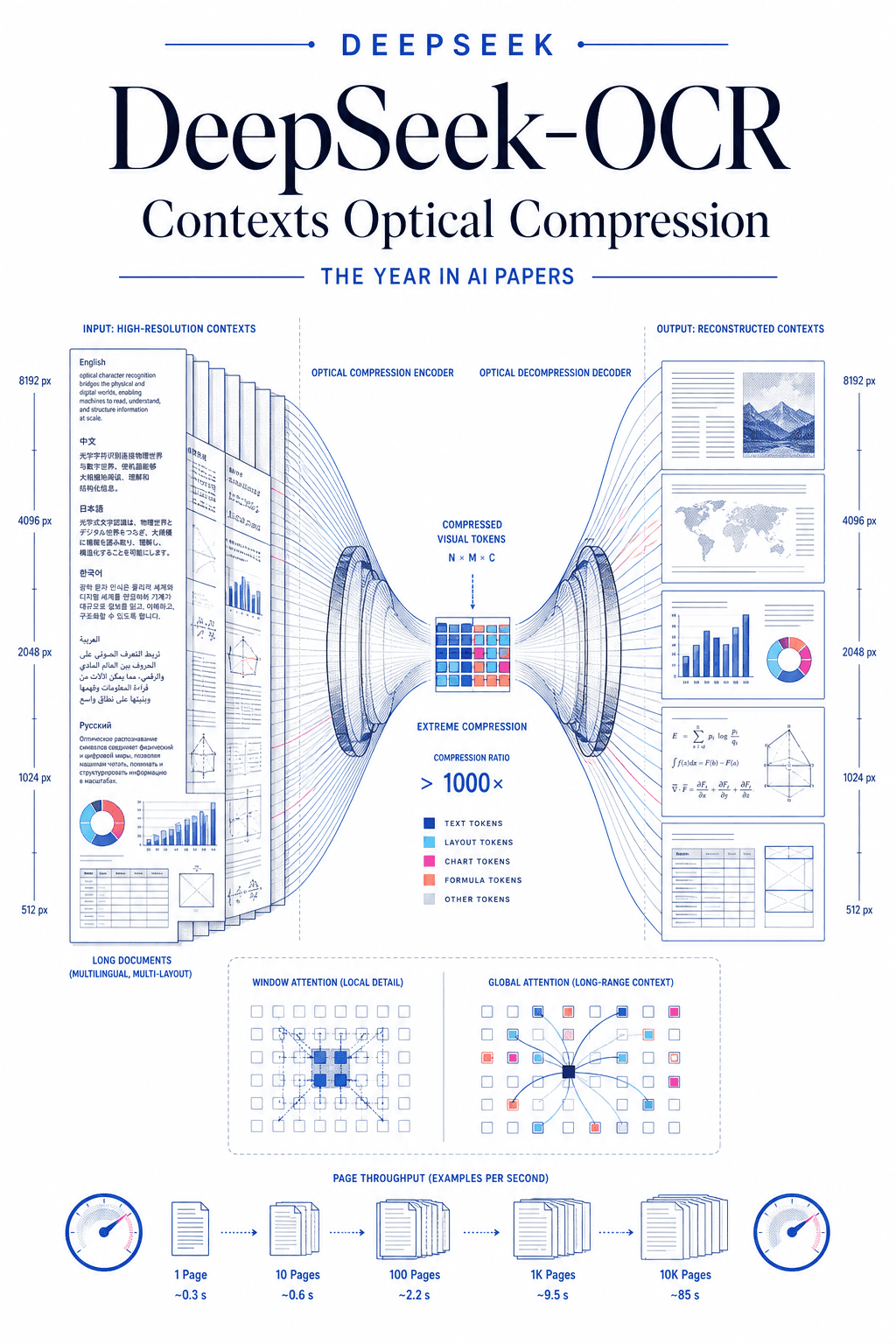
DeepSeek-OCR is a vision-language model that explores optical compression of long contexts by mapping text to images and decoding them back to text.
It consists of DeepEncoder, a novel vision encoder with low activation and high compression, and a DeepSeek3B-MoE decoder.
On the Fox benchmark, it achieves 97% OCR precision at compression ratios under 10x, and about 60% at 20x.
On OmniDocBench, it surpasses GOT-OCR2.0 (256 tokens/page) using only 100 vision tokens, and outperforms MinerU2.0 (6000+ tokens/page) with fewer than 800 tokens.
The model supports multiple resolutions (Tiny, Small, Base, Large, Gundam) and can generate training data at 200k+ pages per day on a single A100-40G.
Training data includes OCR 1.0 (documents, scene text), OCR 2.0 (charts, formulas, geometry), general vision, and text-only data.
The model also supports deep parsing of charts, formulas, and natural images, and handles nearly 100 languages.
The authors propose this as a proof-of-concept for context compression and memory forgetting mechanisms in LLMs.
02 From the paper
Abstract
We present DeepSeek-OCR as an initial investigation into the feasibility of compressing long contexts via optical 2D mapping. DeepSeek-OCR consists of two components: DeepEncoder and DeepSeek3B-MoE-A570M as the decoder. Specifically, DeepEncoder serves as the core engine, designed to maintain low activations under high-resolution input while achieving high compression ratios to ensure an optimal and manageable number of vision tokens. Experiments show that when the number of text tokens is within 10 times that of vision tokens (i.e., a compression ratio < 10x), the model can achieve decoding (OCR) precision of 97%. Even at a compression ratio of 20x, the OCR accuracy still remains at about 60%. This shows considerable promise for research areas such as historical long-context compression and memory forgetting mechanisms in LLMs. Beyond this, DeepSeek-OCR also demonstrates high practical value. On OmniDocBench, it surpasses GOT-OCR2.0 (256 tokens/page) using only 100 vision tokens, and outperforms MinerU2.0 (6000+ tokens per page on average) while utilizing fewer than 800 vision tokens. In production, DeepSeek-OCR can generate training data for LLMs/VLMs at a scale of 200k+ pages per day (a single A100-40G). Codes and model weights are publicly accessible at http://github.com/deepseek-ai/DeepSeek-OCR.